The Infinite Battery Benchmark: How Much Energy Can a Plug-In Solar System Really Offset?
In my previous post, I examined coupling small (1 kWh) to medium (9 kWh) sized batteries with a 1200 W plug-in solar system, and discovered that while they can generally capture the excess energy produced and release it during the night, there are situation where the excess energy wasn’t used by the start of the next day. This was particularly true in the Spring and Fall when mild temperature yet sufficient sunlight resulted is significant energy generation from the solar panels.
That finding sparked a natural theoretical question: What is the absolute upper limit of solar self-sufficiency for a 1,200 W plug-in array if storage capacity were never a constraint?
To find out, I built a continuous, year-round “infinite battery” simulation across all 17,520 half-hour intervals of my historical data (August 1, 2025 through July 31, 2026). In this model, the battery starts at 0% state of charge, has no upper capacity ceiling, charges from surplus solar at a 95% round-trip efficiency (97.47% one-way), and discharges whenever Leg 1 household demand exceeds instantaneous solar production.
The Seasonal Energy Reservoir: Reaching a 45 kWh Peak
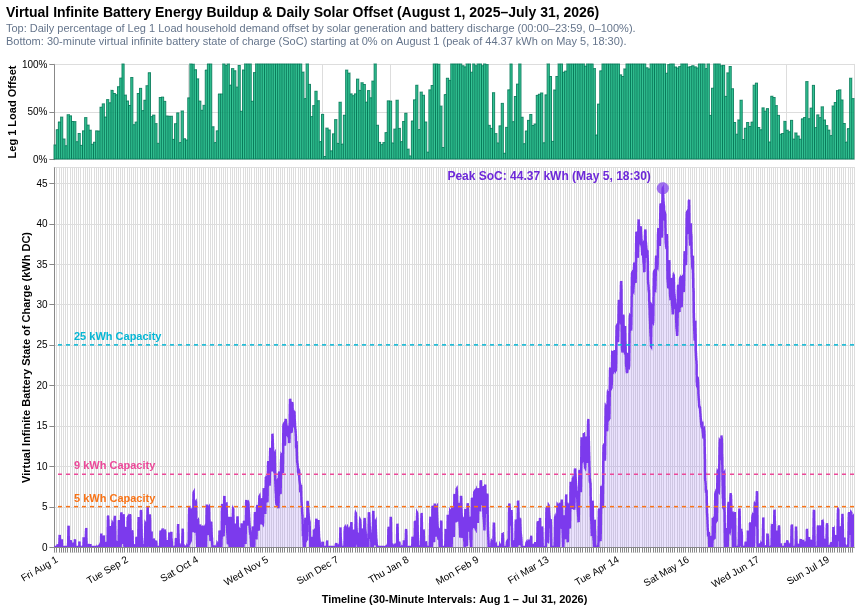
When you remove the arbitrary 3 kWh or 5 kWh hardware caps, the battery shifts from a short-term diurnal buffer (storing energy by day for evening use) into a massive multi-month seasonal reservoir:
- Late Summer and Autumn (August through October): Modest daily surpluses are captured and immediately drawn down overnight. Storage oscillates near the bottom of the tank (0 to 5 kWh).
- Late Autumn (November): Excess generation and moderate temperature resulting in no AC usage, results in a peak state of charge of 18.32 kWh and the ability to meet 100% of Leg 1 demand for three weeks continuously.
- Winter Deficit (December to February): Shorter daylight hours and cloud cover mean nearly all generated solar power is consumed instantaneously by baseline loads. The battery state of charge again oscillates between 0 and 5 kWh.
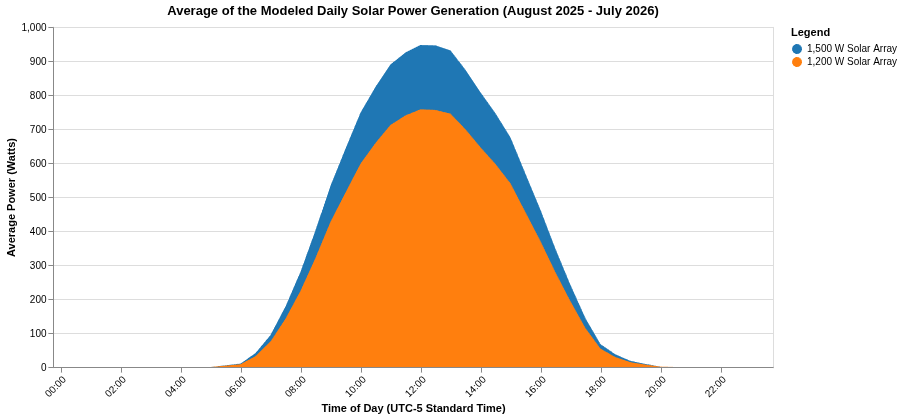
- The Spring Surplus Surge (March to the middle of May): As daylight expands and sunny, mild days produce 7 to 9 kWh of daily DC generation with minimal heating or cooling loads, excess solar accumulates day after day faster than Leg 1 can consume it overnight. The annual apex state of charge of 44.37 kWh is reached on May 5, 2026. This results in the system being able to meet an astounding 83.77% of the total demand for Leg 1 during this period.
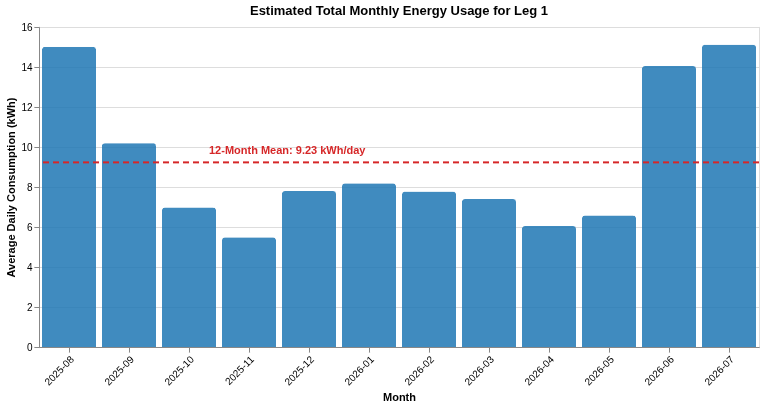
- The Summer Drawdown (Mid May through July): As summer arrives and higher temperatures result in prolonged air conditioning use and heat-throttled energy generation, plust the addition of the electric car to household electrical usage, Leg 1 consumption overtakes solar generation. The 45 kWh reserve is reduced all the way back down to 0 kWh by the end of May.
A usable capacity of 45 kWh is roughly the size of a standard Nissan Leaf or base Tesla Model 3 battery pack. It represents the exact amount of chemical storage required to ensure that not a single watt-hour of surplus solar electricity is ever exported to the grid uncredited across an entire year.
The Upper Bound: Annual Energy Offset Breakdown
With a 45 kWh battery capturing 100% of excess solar electrons, what fraction of the home's electricity consumption does the 1,200 W system offset?
| Metric | Annual Energy (kWh) | Share of Leg 1 Demand | Share of Whole-House Demand |
|---|---|---|---|
| Whole-House Total Consumption | 6,731.80 kWh | — | 100.000% |
| Leg 1 Consumption (50% Split-Phase) | 3,365.90 kWh | 100.000% | 50.000% |
| 1,200 W Solar Array DC Generation | 2,061.85 kWh | 61.257% | 30.628% |
| Total AC Energy Delivered to Leg 1 (Solar + Battery + 95% Eff.) | 1,911.46 kWh | 56.789% | 28.395% |
| Unmet Energy Drawn from Grid on Leg 1 | 1,454.44 kWh | 43.211% | 21.605% |
Even with an EV-sized 45 kWh seasonal battery capturing every excess electron generated:
- The system offsets 56.79% of the electrical consumption on the plug-in circuit's phase (Leg 1).
- Across the entire household (both phases combined), it offsets 28.395% of total annual demand.
Energy vs. Power: Why a Full 45 kWh Battery Still Cannot Cover 100% of Daily Leg 1 Usage
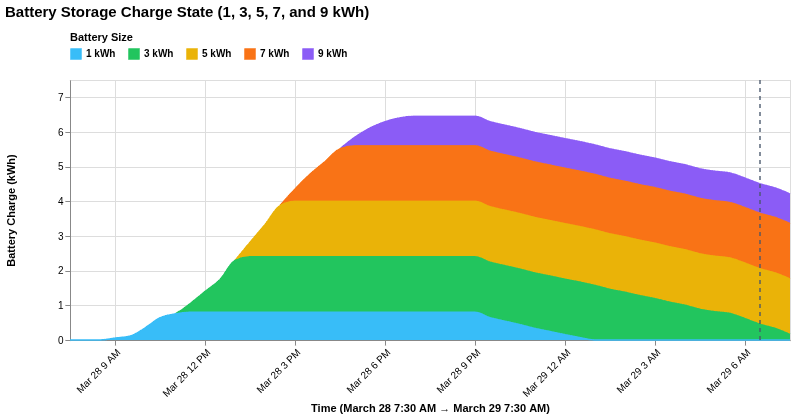
The state-of-charge chart demonstrated numerous days where the batter contained more energy than the total daily demand for Leg 1. Why couldn’t the battery meet 100% of the demand in those situations?
This highlights the critical engineering distinction between energy capacity (kWh) and instantaneous power (kW):
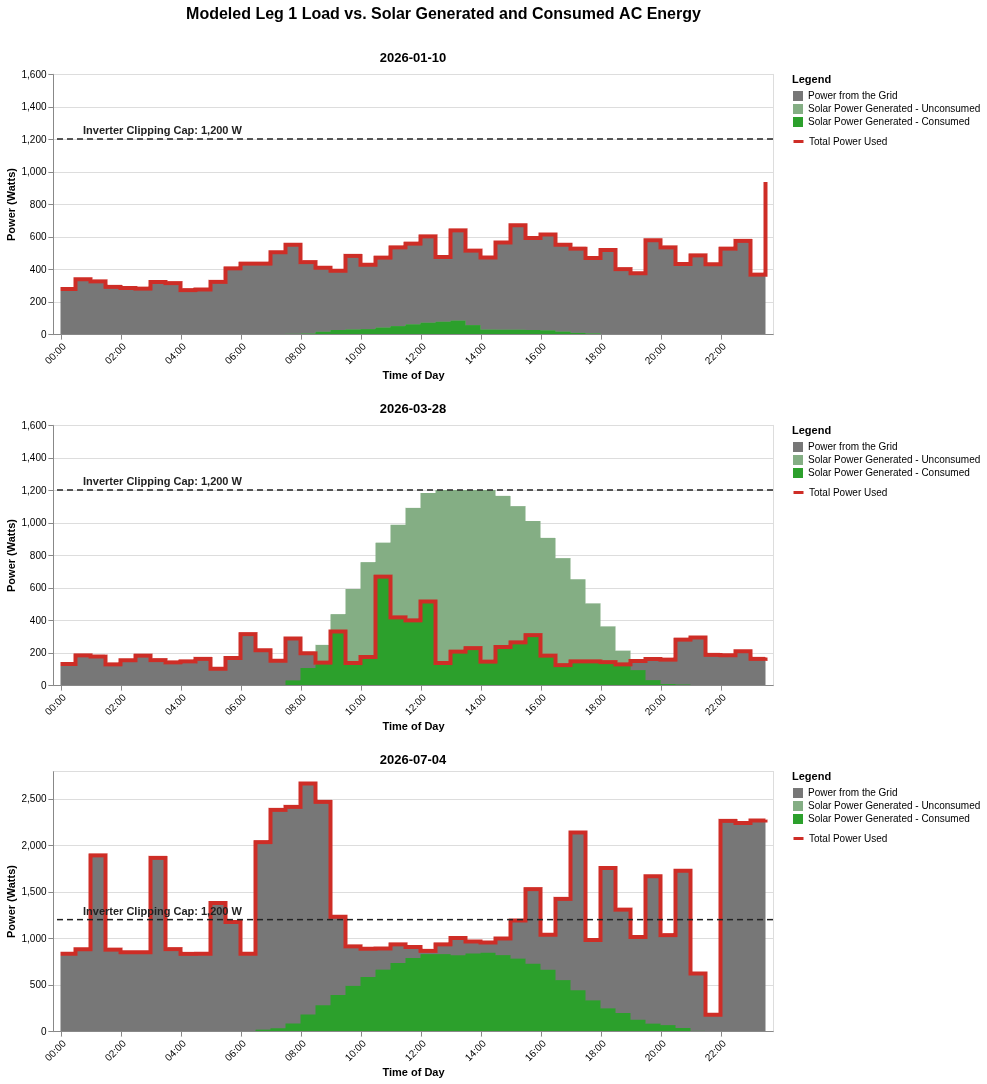
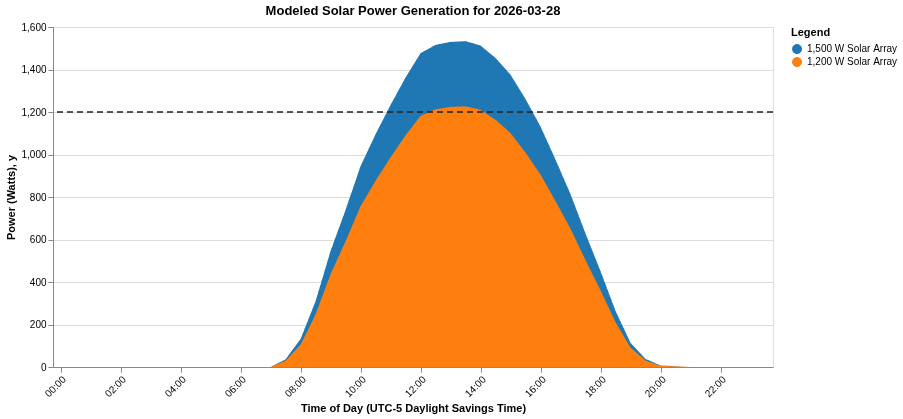
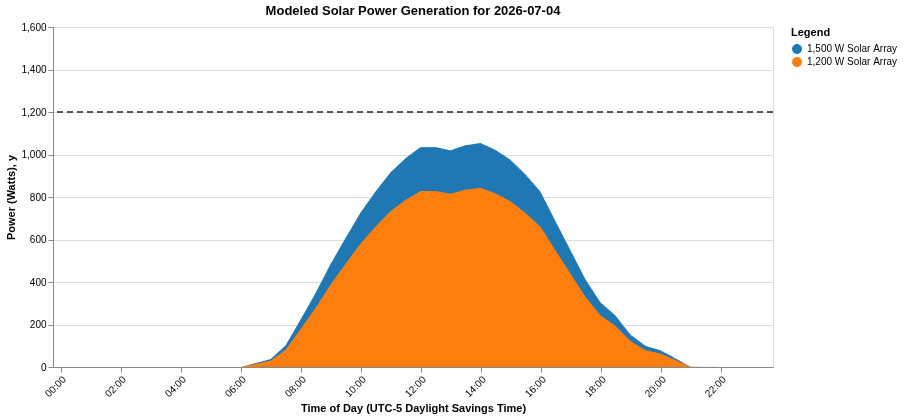
- The 1,200 W Inverter Ceiling: To comply with National Electrical Code (NEC) rules for standard 15-amp branch circuits (continuous duty limited to 80% of rating, or 12 amps at 120 volts), the plug-in microinverter cannot feed more than 1,200 W continuous AC into the wall receptacle.
- Instantaneous Household Peaks: Household circuits regularly experience high-demand spikes. Devices such as AC (> 2,500 W), on a microwave (1,400 W), or a hairdryer (1,500 W) added on top of baseloads push Leg 1 demand beyond 1,200 W.
- The Power Bottleneck: When demand on Leg 1 increases beyond the 1,200 W limit of the inverter, the utility grid supplies the additional power even though there may be sufficient energy in the battery to meet the need.
Across the modeled year, Leg 1 demand exceeded the 1,200 W ceiling in 899 distinct 30-minute intervals. In 301 of those intervals, the virtual battery had ample stored energy in reserve, but the 1,200 W inverter limit prevented the system from covering the spike.
Key Takeaways for System Design
- The maximum theoretical ceiling: In this scenario, a 1,200 W plug-in solar array with infinite seasonal storage can offset at most 56.79% of Leg 1 and 28.40% of whole-house energy.
- The perfect battery is economically absurd: The cost of home battery storage has been rapidly falling, but as of 2026 costs generally are well above \$300/kWh. This would make a 45 kWh battery at least \$13,500. In this scenario, the 45 kWh of storage needed to capture all excess generation (~500 kWh) from tje 1,200 W solar array would take over 150 years to break even, as it only represents \$90 of annual savings at \$0.18/kWh.
- Power Matters Just as Much as Energy: Storing excess energy is only half the battle. Because plug-in systems are strictly restricted to 1,200 W continuous output, higher-power household loads will always rely on grid support.
- The Path Forward: Plug-in batteries still provide valuable storage capabilities, provided they are kept to a reasonable, cost-effective size. Future analysis will utilize linear programming optimization to identify the ideal battery capacity that balances maximum cost-efficiency with energy offset value.